
Mug Clubs: The Complete Guide for Breweries (2026)
By Brian Winckel · Founder, Brewlytics.ai
Short Answer
A mug club is a paid brewery membership: dues in exchange for a personal mug, a bigger or discounted pour, and early access to releases. It works as a business when members visit more often after joining than they did before — that single number, not the dues, decides whether the club makes money. Price the perk in liquid cost, cap the first cohort, tag members in your POS so their visits are countable, and review the cohort at month eight rather than at renewal, when it is too late to fix.
Barley's Take
A mug club isn't a wall of mugs. It's a list of people who told you they want to come back — and then a question of whether anyone checked if they did.
Why This Matters for Breweries
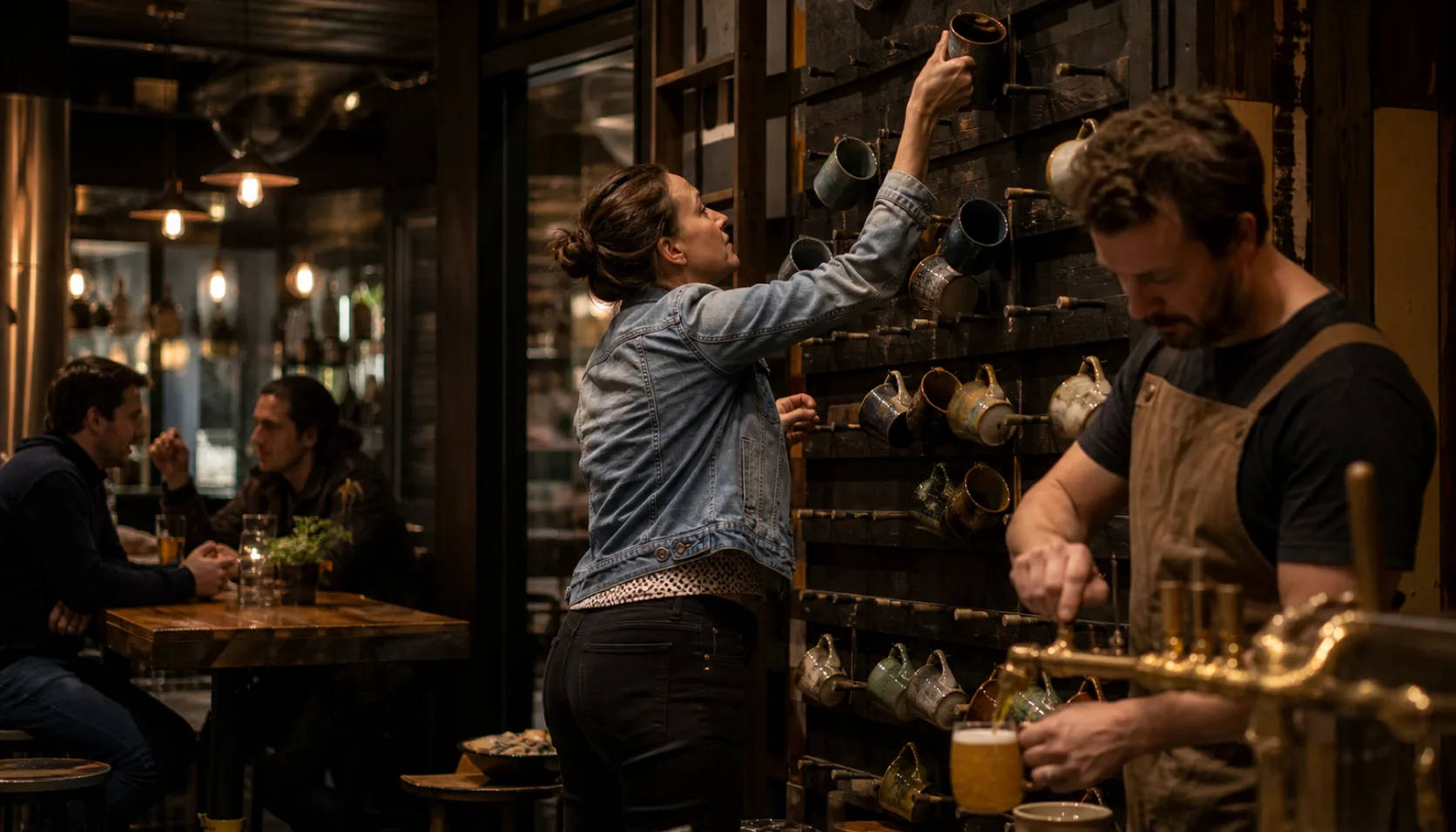
Walk into almost any 5-barrel taproom in the country and there's a wall of numbered ceramic mugs behind the bar. Some of those walls are the most profitable square footage in the building. Most are decoration — a shelf of dusty mugs belonging to people who paid $150 two years ago, drank four pilsners, and haven't been back since the Christmas release.
Both walls look identical. That's the problem. A mug club — a paid brewery membership where a guest pays recurring dues in exchange for a personal vessel, an upgraded or discounted pour, and early access to beer — is one of the few things a taproom can sell that generates cash before the beer is brewed. It's also one of the few loyalty mechanics that customers ask for by name.
But dues are the smallest number in the whole model. A member paying $150 a year who buys $600 of beer is not a $150 customer. Which means the club's profitability isn't set by what you charge — it's set by whether membership actually changed how often that person walks in. Most breweries never find out, because the mug wall doesn't count visits and the punch card doesn't either.
This guide covers the four ways to structure a club, the arithmetic that decides whether yours is working, the perks worth paying for, and the operational habits that catch a lapsing member while there's still time to do something about it.
How It Works
Every mug club is selling three things in some combination: volume (a larger or cheaper pour), access (releases, allocations, events before anyone else), and status (a mug with your number on it, and staff who know it's yours). The models below just weight those three differently.
The four models breweries run
| Model | How the member pays | What it's good at | What it costs you |
|---|---|---|---|
| Annual dues | One lump, e.g. $150/yr | Clean cash flow, simple to explain, easy to cap | A renewal cliff every twelve months, all at once |
| Monthly subscription | Card on file, e.g. $15/mo | Highest lifetime value; no renewal event to lose | Quiet churn — members leave without telling you |
| Lifetime / founder mug | One-time, e.g. $400 | Excellent for a build-out or opening year | A perk liability you carry forever, unfunded |
| Tiered club | e.g. $99 / $199 / $349 | Best revenue per member; sells to your top 5% | Real administration — allocations, events, tracking |
Most taprooms should start with annual dues and a hard cap. Subscription billing is the better long-term structure, but only once you have card-on-file infrastructure and someone who watches churn; otherwise you've swapped a visible renewal problem for an invisible one.
The math that decides everything
Run this before you print a single mug. Five steps:
- Establish the baseline. For the people likely to join, how many times a year do they come in now, and what's their average check? If you can't answer this from your POS, that's the first thing to fix — not the club.
- Price the perk in liquid, not retail. A 20 oz pour sold at the 16 oz price gives away 4 oz. At retail that feels like $2. In liquid cost it's cents. Retail is the wrong number unless the member would have bought the larger pour anyway.
- Add the fixed costs. The ceramic mug itself, artwork, the peg board, the staff time to run enrollment. This is a per-member number you pay once, in the first month.
- Multiply by the visit lift. Baseline visits versus member visits, times average check. This is the only line in the model that can swing the answer, and it's the one every brewery guesses at.
- Check the cohort at month eight, not month twelve. A member who has come in twice by August will not renew in January. At month eight you can still change that. At renewal you're reading a post-mortem.
Perks, ranked by what they cost you
Cheap and genuinely valued:
- First pour of every new release — costs nothing, and it's the reason a member checks whether you tapped something this week.
- A pilot-batch tasting members can't buy — one 10-gallon batch, one Thursday, enormous status value.
- Name and number on the wall. Free. Still the single most-cited reason people join.
- Allocation on limited cans — you were going to sell them anyway; selling them to members first costs zero and prevents a line at 8 a.m.
Expensive and forgettable:
- A percentage off everything, including food. Unbounded, unmeasurable, and it trains members to think of you as a discount.
- Merch bundled into dues. A t-shirt is $9 of cost that produces no visit.
- Free beer on a birthday the member has to remember to claim.
Example Brewery Scenario
Ninth Street Brewing is a 7-barrel taproom running Square. Their board is four core beers — Cutback Pils, Overcast Hazy IPA, Ledger Stout, and a rotating sour — plus a quarterly barrel-aged release that sells out in a weekend.
They cap the club at 140 mugs, $150 a year, sold in one January push. Members get 20 oz pours at the 16 oz price ($8) and first crack at every barrel-aged release. Dues bring in $21,000 in the first two weeks of the year — roughly a fermenter, paid for before a single member drinks anything.
Twelve months in, Square tells them what the mug wall couldn't. Members averaged 26 visits against 11 for their non-member regulars, at a $24 average check. That's about $87,000 in member spend on top of the dues. The perk cost: two pours a visit, 4 oz upgraded each, across 26 visits and 140 members — around 29,000 oz of liquid, or roughly 1,800 pints given away at cost, not retail. Add $14 a mug in year one. The club is not close to a losing proposition.
Then the uncomfortable line. Thirty-eight of the 140 came in fewer than six times all year. They bought a mug, drank a Cutback in February, and vanished. Nobody noticed, because nobody was counting — and in January, 30 of those 38 didn't renew. That's $4,500 of dues gone and, more importantly, 30 people who told you in writing they wanted to be regulars and then weren't.
The fix costs nothing and takes one query: in August, pull every member under six visits and send them a message about the Overcast batch they rated five stars in February.
Practical Checklist
Do these this week, in this order. Most of them are decisions, not projects.
- Pull last year's transactions and find the visit frequency of your top 200 guests. That number is your baseline.
- Pick one model and one price. Annual dues with a hard cap is the right default.
- Cap the first cohort at a number you can physically hang on a wall. Scarcity does the marketing for you.
- Cost the headline perk in liquid before you announce it, not after.
- Collect a phone number at enrollment, not just a name for the mug. Phone is the identifier that survives across POS, SMS, and loyalty.
- Tag members in your POS so their visits are countable without a spreadsheet.
- Put a month-eight review on the calendar now, with a name attached to it.
- Reserve one perk nobody can buy — a pilot batch, an allocation, the first pour.
- Draft the renewal message in early January, when the mug is still in their hand, not on December 30th.
How Brewlytics Helps
The mug club software market splits neatly: tools that bill dues, and tools that know what members drink (we compare nine of them in Best Mug Club App & Software for Breweries). Membership-first platforms handle the first half well — MugClub.beer publishes a free tier up to 100 members and paid plans at $49, $99, and $149 a month (verified 2026-08-18), while Oznr and CraftPeak quote privately. What almost none of them do is the second half, because the transactions that would answer "did membership change this person's behavior" happen in your POS, not in the billing tool.
Brewlytics sits on the measurement side:
- POS Sync reads Square today — transactions and the beer catalog — so member visits and spend are counted automatically instead of estimated at renewal. The Square integration is self-serve; Toast is next on the roadmap, then Arryved. If you're on another system, it won't connect yet.
- Rewards runs the club mechanics — tiers, perks, member status — without a punch card or a laminated list behind the bar. See loyalty and rewards.
- Customer Taste Profiles mean a member isn't just "member #83." They're the person who orders the hazy every Friday and has never touched the stout, which is what makes a members-first release alert land. See customer insights.
- Campaign Automation sends the month-eight message to the members who've gone quiet, and gives members the release alert twenty-four hours before everyone else.
Brewlytics is free to start, with Pro at $99/mo plus a per-active-customer fee. For where a club fits alongside events, email, and release marketing, start with the complete brewery marketing guide. For why paid memberships outperform punch cards on retention, read why traditional brewery loyalty programs don't create true regulars, and for the members-only night itself, brewery event ideas that drive revenue.
FAQ
See the schema-ready FAQ block at the end of the page for the full set — covers what a mug club is, how to price dues, whether clubs are profitable, cohort size, club versus loyalty program, the software you actually need, how to manage a club without it becoming a second job, how members join, and what to look for in the mugs themselves.
Ready to run a mug club you can measure?
You don't need a new POS or a rebuilt mug wall. You need your members tagged, their visits counted, and someone looking at that number in August instead of January.
→ Book a demo and bring your Square account. → See how Brewlytics works for breweries before you talk to anyone.
Frequently asked questions
Related Brewlytics Feature
Rewards
Brewery loyalty mechanics that don't require discounting beer.
See how it works →Keep reading
Best Brewery Loyalty Software for Taprooms (2026)
Eight brewery loyalty tools compared for 2026: Square, Toast, Arryved, MugClub.beer, TapWyse, LoyalBrew, Untappd and Brewlytics, with a best-for pick for each.
Best Mug Club App & Software for Breweries (2026)
Nine mug club apps compared for 2026 — MugClub.beer, Oznr, TapWyse, CraftPeak, Submatic, LoyalBrew and Brewlytics — with verified pricing and the POS gap.
Nobody Comes Back to My Brewery — Here's Why (And the One Fix That Works)
Most first-time taproom visitors liked your beer fine. They just forgot about you. Why brewery customers only come once — and the one fix that works.
Want to see this working in your brewery?
Go Pro to see your customers and act on the data — taste profiles, segmented iMessage, SMS + email campaigns, the AI bartender, and the full dashboard. Or book a walkthrough with the brewer who built it. Not ready? Start free, no card.
Just here for the beer? Get the free Barley app