
Email Marketing for Breweries: The Complete Playbook
By Brian Winckel · Founder, Brewlytics.ai
Short Answer
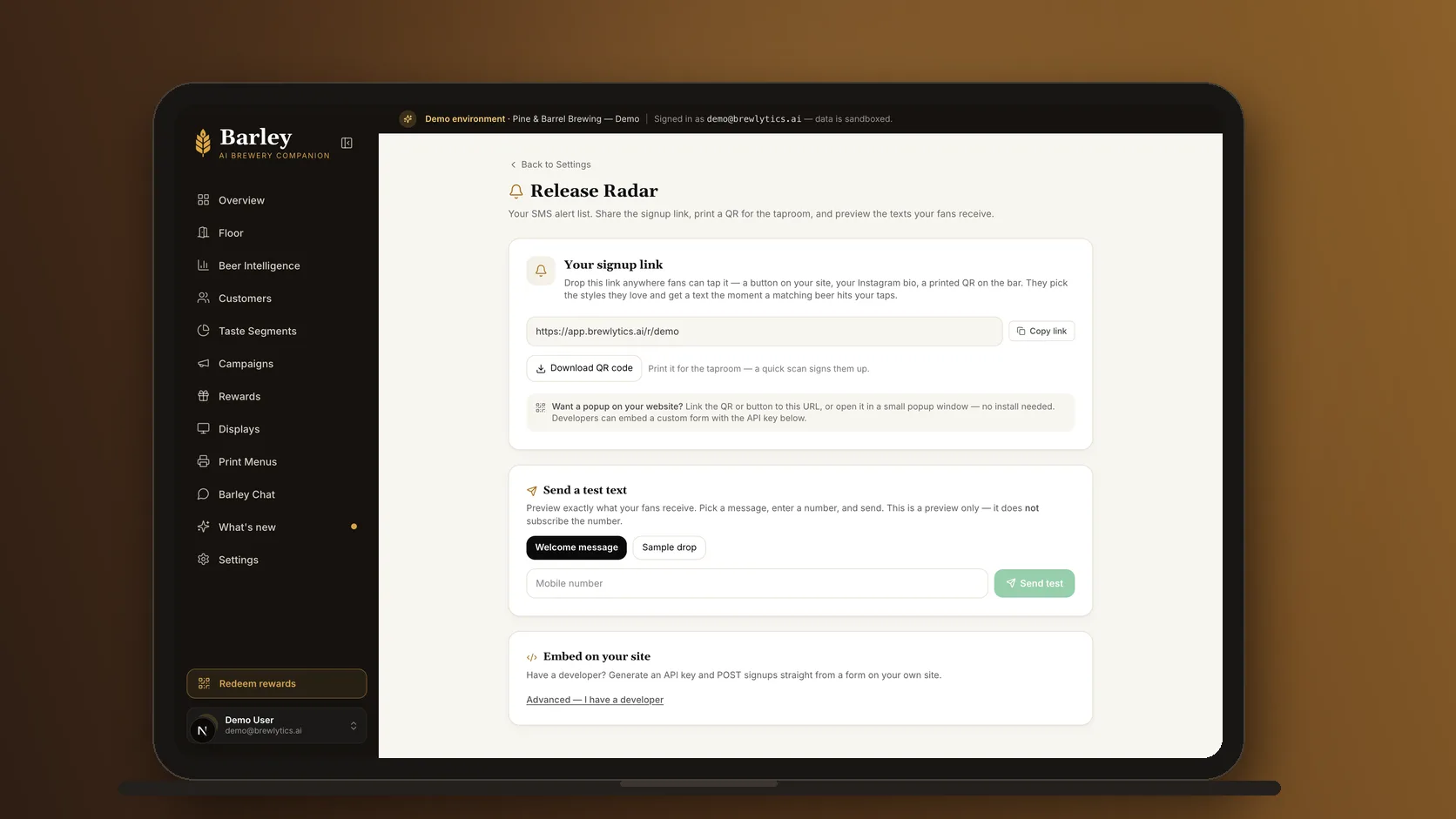
Email marketing for breweries works because you own the list and delivery rates sit near 98%, far above social media's organic reach. Build the list through WiFi capture, QR codes at the bar, checkout prompts, website popups, event signups, and loyalty enrollment. Send 2-4 emails per month across eight proven types: new releases, tap list updates, event invites, seasonal sends, brewer stories, customer milestones, reactivation, and exclusive access. The biggest lever is segmentation — sending taste-matched messages to the right customers instead of blasting everyone. Healthy benchmarks are 25-30% open rates, 3-5% click rates, and under 0.5% unsubscribes. Use email for storytelling and SMS for time-sensitive alerts.
Barley's Take
Most brewery email programs die of two diseases: not enough subscribers (because nobody asked at the bar) and too many blasts (because the same message goes to everyone). Fix the first by making signup effortless — WiFi, QR, checkout — and fix the second by matching the beer to the drinker. An email about a hazy IPA that lands only in the inbox of someone who loves hazies isn't marketing. It's a favor.
Why This Matters for Breweries
Here's a number worth remembering: email reaches roughly 98% of the inboxes you send to. An Instagram post reaches 2-6% of your followers. A Facebook post, even less. Email isn't glamorous, but it's the only marketing channel where the math hasn't collapsed.
The catch is that most brewery email programs underperform — not because email is broken, but because the execution is. A generic Tuesday blast to the whole list trains customers to ignore you. An unsegmented newsletter about your new hazy IPA goes to the stout lover and the lager loyalist and the person who visited once six months ago and forgot your name. Everyone gets the same message. Almost nobody acts on it.
This playbook is for the brewery owner, taproom manager, or one-person marketing team who knows email should be working harder but isn't sure where to start — or where to fix what they've already built. We'll cover building your list from zero, the eight email types that actually drive visits, when to blast versus segment, how often to send, and the benchmarks that tell you whether it's working.
Building Your Email List from Scratch
You can't email customers you don't have. List building is the first job, and the good news is that breweries have a massive advantage over ecommerce brands: your customers physically walk into your space multiple times a month. You don't have to buy attention — you just have to ask for it at the right moment.
Here are six methods that work, roughly in order of how many emails they'll collect.
1. WiFi capture
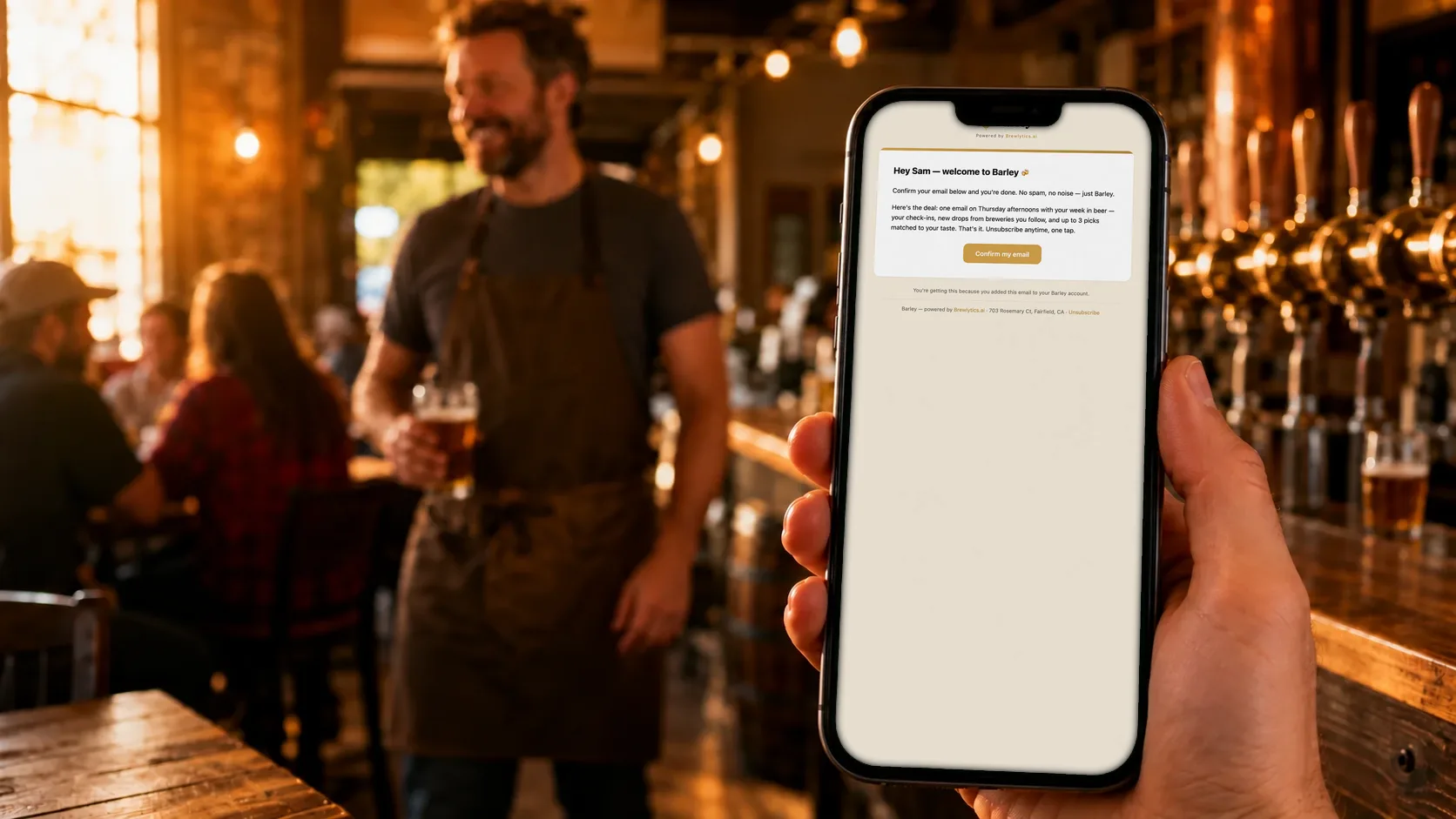
Offer free guest WiFi and gate it behind an email address. The customer types their email to get online, and you've got a subscriber who was going to sit in your taproom anyway. This is the single highest-volume list builder for most taprooms — it runs passively, 7 days a week, without your staff doing anything. Tools like Beambox, GoZone, or your router's built-in portal can handle this for under $50/month.
2. QR codes at the bar and on table tents
A small sign that says "Scan to get notified about new releases" with a QR code linking to a signup form. Place it on table tents, at the bar, near the register, and in the restroom (yes, really — captive audience). The key is a clear value proposition: not "join our mailing list" (boring) but "be the first to know when we tap something new" (useful).
3. The checkout ask
Train your bartenders to ask one question at close-out: "Want us to text or email you when we release something new?" It takes five seconds, it's personal, and it converts at a surprisingly high rate because the customer is already in a good mood — they just had a great experience. Even if only 1 in 5 says yes, that adds up fast across a busy week.
4. Website popup
A simple popup or banner on your website offering a reason to subscribe. "Get our tap list and new releases in your inbox" works. Time it to appear after 5-10 seconds or on scroll — don't hit people the instant the page loads. Make sure it's mobile-friendly; most brewery website visitors are on their phones.
5. Event signups
Every event is a list-building opportunity. Trivia night registration, release party RSVPs, brewery tour bookings — all of these collect an email as part of the signup flow. If you're running events without capturing contact information, you're leaving subscribers on the table.
6. Loyalty program enrollment
When someone joins your rewards or mug club program, you get their email (and usually their phone number) as part of the process. Loyalty members are your most valuable email subscribers because they've already signaled they want a relationship with your brewery. This is the deepest form of opt-in.
The compound effect: A taproom using all six methods can realistically add 50-150 emails per week. In six months, that's a list of 1,500-4,000 — more than enough to run a serious email program. The key is making signup effortless and always-on, not a one-time push.
What to Actually Send: 8 Email Types That Work
The biggest mistake in brewery email marketing isn't sending too much — it's sending the same thing every time. A healthy email program mixes several types of content so your subscribers never know quite what to expect (in a good way). Here are the eight that earn their keep.
1. New release announcements
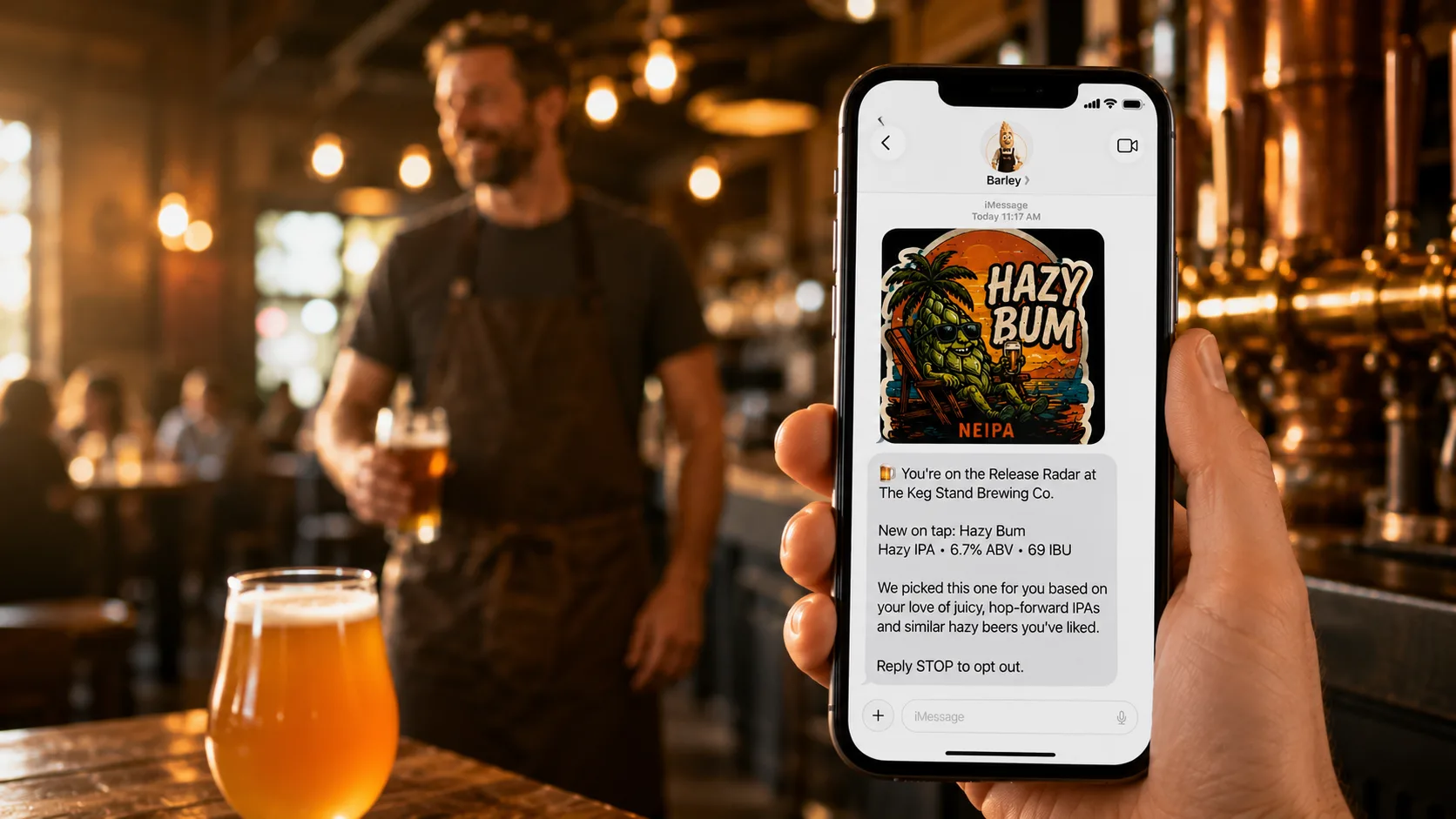
The crown jewel. When a new beer hits the taps or the shelf, the people who'd love it should hear about it immediately. Describe the beer in sensory terms — not just the style, but the experience. "Our new Galaxy single-hop pale is bright, tropical, and dangerously easy to drink at 5.2%" tells a customer whether this is their thing. This is also the email type that benefits most from segmentation (more on that below).
2. Tap list updates
A weekly or biweekly roundup of what's currently pouring. Keep it visual and scannable — beer name, style, a one-line flavor note, and ABV. Some breweries include a "pouring this week only" flag to create urgency. This is your bread-and-butter email: reliable, useful, and a reason to visit.
3. Event invites
Trivia night, live music, release parties, food truck rallies, beer dinners. Send the invite 5-7 days before the event with a clear date, time, and what to expect. Include a calendar link or RSVP button. Events are one of the top reasons people open brewery emails — they're looking for a reason to come out this week. (Short on ideas? 25 brewery event ideas that actually drive revenue has a full slate organized by type.)
4. Seasonal and holiday sends
Oktoberfest lineup, holiday gift guide (growlers, gift cards, merch), summer session ales, dark beer season kickoff. These feel timely and relevant because they're tied to something the customer is already thinking about. Plan these 2-3 weeks ahead so you're not scrambling.
5. Behind-the-scenes and brewer stories
People buy beer from people, not logos. A short email about how a recipe was developed, what inspired a seasonal, or a day-in-the-life of your head brewer builds a connection that transcends the product. These emails often get the highest engagement rates because they feel personal and can't be replicated by a competitor.
6. Customer milestones
"Happy anniversary — it's been one year since your first visit." "You've tried 25 of our beers." "Happy birthday — your next pint is on us." Milestone emails feel personal because they are. They require customer data to trigger, but the payoff is outsized: a well-timed milestone email can reactivate a lapsed customer or deepen a regular's loyalty in a way no blast ever could.
7. Reactivation — "we miss you"
When someone hasn't visited in 60-90 days, a gentle nudge works better than you'd think. The key is to make it specific, not generic. "We miss you" is weak. "We just tapped a beer that's right up your alley — a juicy, tropical hazy that's peak-fresh right now" gives them a reason to come back. This email type has one of the highest revenue-per-send rates when done well.
8. Exclusive and early access
Give your email subscribers something they can't get on social media: early access to a limited release, first dibs on event tickets, or a subscriber-only discount. This creates a tangible reason to stay on the list and trains customers to open your emails because they might miss something. Exclusivity doesn't have to mean expensive — it just means first.
The Blast-vs-Segment Debate
This is where most brewery email programs leak the most value, so it's worth spending a minute here.
A blast is a single message sent to your entire list. Every subscriber sees the same thing. It's fast, it's easy, and it's what most breweries do by default.
A segmented send is the same message sent only to the subscribers who'd care about it. Instead of emailing 2,000 people about your new double IPA, you email the 300 who've ordered IPAs before. The other 1,700 never get pinged.
Why does this matter? Three reasons:
- Relevance drives action. A customer who loves IPAs is far more likely to open, click, and visit when the email is about an IPA. The stout drinker who gets that same email learns to ignore you.
- Blasts erode your list. Every irrelevant email increases the chance of an unsubscribe. Lose enough subscribers and you're rebuilding the list you spent months growing.
- Deliverability rewards relevance. Email providers (Gmail, Outlook) track engagement. If your emails consistently get low opens and high deletes, they start routing you to spam. Segmented sends with higher engagement keep you in the inbox.
The practical example: Cedar & Pine Brewing has 1,400 email subscribers. They release a new hazy IPA and blast the whole list. Open rate: 18%. Click rate: 1.2%. Three people mention the email when they visit.
The next month, they segment. They send the hazy IPA announcement only to the ~300 subscribers who've ordered IPAs or hazies before. Open rate: 38%. Click rate: 6.1%. Fourteen people come in and mention the email. Same beer, same copy — better targeting.
Segmentation doesn't mean you never send to the full list. Big events, taproom hours changes, and seasonal lineup reveals are legitimately for everyone. The rule of thumb: if the content is about a specific beer or beer style, segment. If it's about the brewery as a whole, send broadly.
For a deeper look at why the blast-to-everyone approach has been losing ground, see why brewery email blasts don't work like they used to.
How Often to Send
The sweet spot for brewery email marketing is 2-4 sends per month. Here's why that range works:
- Less than twice a month and subscribers forget who you are. Your next email feels unfamiliar, open rates drop, and you lose the relationship cadence.
- More than once a week and you burn the list. Unsubscribes climb, engagement falls, and you train people to reflexively delete. The exception is if you're running a truly event-heavy week (a festival, a major release weekend) — an extra send is fine when there's a genuine reason.
A practical rhythm: one anchor email per week (tap list update or newsletter) plus additional sends only when something warrants it (a release, an event, a milestone). That keeps you present without becoming noise.
Watch the unsubscribe rate. If it spikes after a send, that's your audience telling you you've overstepped — either in frequency or relevance. A healthy unsubscribe rate per email is under 0.5%. Consistently above 1% means something needs to change.
Subject Lines That Work for Breweries
Your subject line is the only thing standing between your email and the trash folder. Here's what works for brewery email marketing:
Specific beats clever. "Fresh Double IPA just tapped — tropical, juicy, 7.8%" will outperform "Big News This Week!" every time. The first tells the reader exactly what they're getting. The second could be anything — and when it could be anything, it's nothing.
What works:
- "New on tap: Galaxy Single-Hop Pale (bright, tropical, 5.2%)"
- "Trivia this Thursday — free pint for the winning team"
- "Your favorite hazy is back. Limited kegs."
- "Dark beer season starts Friday. Here's the lineup."
What doesn't:
- "Weekly Newsletter #47"
- "Check out what's happening at [Brewery Name]!"
- "You won't want to miss this"
- Emoji-heavy subject lines that feel like spam
The pattern: tell the reader what's in it for them, in plain language, in under 50 characters when possible. Beer names, flavor descriptors, and urgency (limited, fresh, just tapped) all help.
SMS vs. Email: When to Use Which
Most breweries should run both channels. They're complementary, not competing. Here's the split:
Use SMS for:
- Time-sensitive alerts (a beer just tapped, a keg is about to kick, same-day event reminder)
- Short, action-oriented messages ("New hazy is on. Tasting room open until 10.")
- Urgent promotions (happy hour starting now, last chance for event tickets)
Use email for:
- Longer storytelling (brewer profiles, recipe deep-dives, event recaps)
- Visual content (tap list with descriptions, event flyers, seasonal lineups)
- Content that benefits from formatting (headers, images, links)
The key difference: SMS gets read within minutes — open rates run above 90%. But it's intrusive, so you can only use it sparingly (once a week at most) and for things that are genuinely urgent. Email is less intrusive but also less immediate — it's for the messages that can wait a few hours. Together, they cover the full range of what a brewery needs to communicate.
For more on the automation side of both channels, see automated marketing for breweries: what to automate and what not to.
Tools: Generic vs. Purpose-Built
You have options. Here's an honest comparison:
Mailchimp and Constant Contact are the workhorses of small-business email marketing. They're affordable, well-documented, and handle list management, templates, automations, and basic segmentation competently. For a brewery that just needs to send a weekly newsletter and the occasional event invite, they get the job done.
Where they stop: they can segment by email behavior (opened, clicked, purchased) and by whatever custom fields you manually maintain. They cannot segment by taste. They don't know that Customer A loves tropical hazies and Customer B only drinks dark lagers — because they don't have a beer-taste profile layer. For those tools, every subscriber is just an email address with a click history.
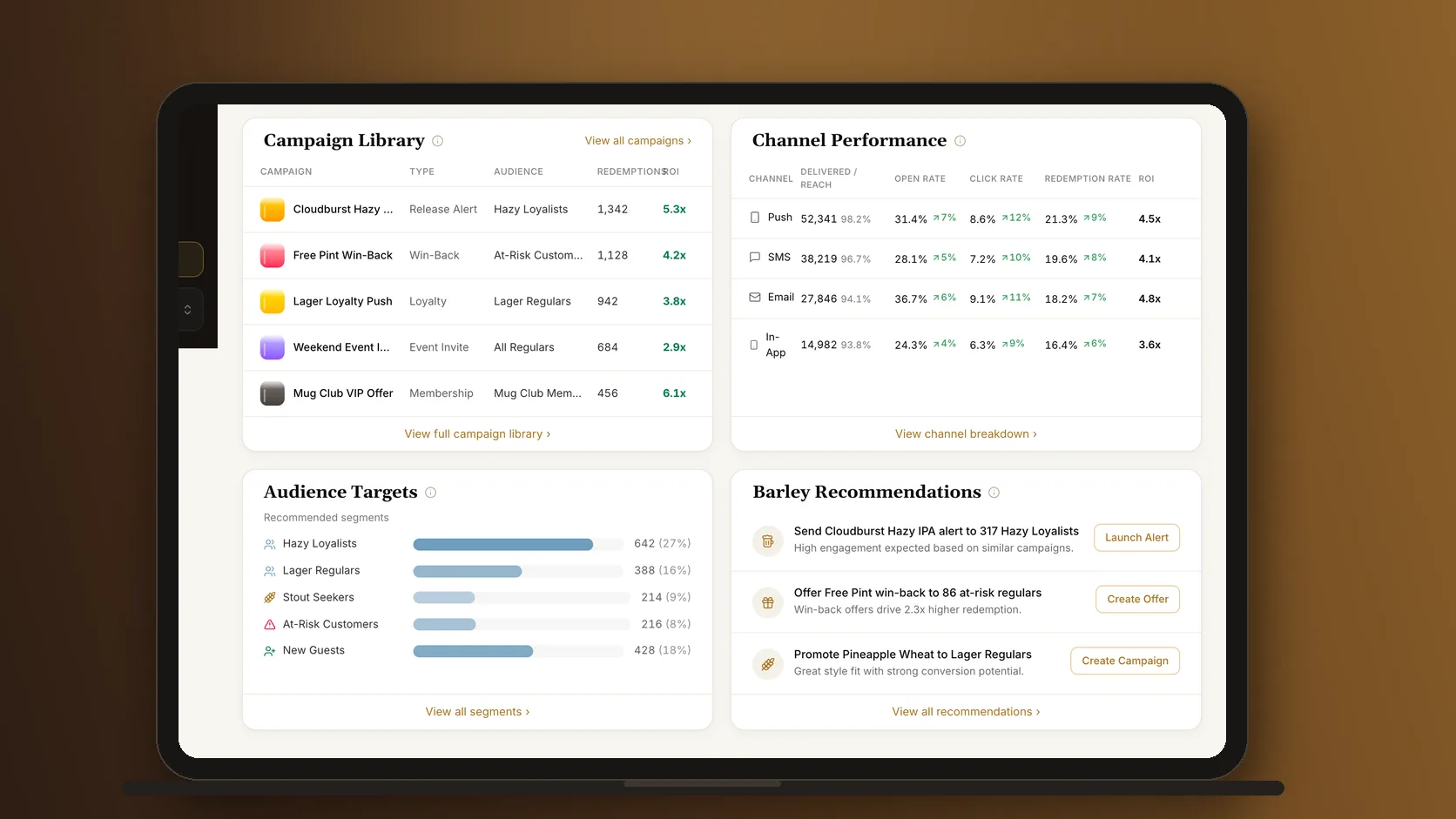
Brewlytics is built as a brewery-specific marketing platform that sits on top of your POS — Square today, with Toast and Arryved on the roadmap — and adds the taste layer. Every customer has a taste profile built from their purchase history and in-app ratings. When you send a release alert, it can go to exactly the customers whose palates match that beer — not just "people who opened your last email." It sends over iMessage and SMS, in-app messaging, and — as of September 2026 — email campaigns too, all from the same taste segments. The email side is deliberately plain: a subject, a body, your branding, a per-recipient unsubscribe. It is not a drag-and-drop newsletter designer, so if elaborate templates are the job, Brewlytics is the taste layer underneath whatever you send rather than a Mailchimp replacement.
The tradeoff is straightforward: if you just need email, a generic tool works fine. If you want your outreach to know what each customer actually drinks, you need the taste data underneath it — and that's the layer generic tools don't have. For a full side-by-side of the platforms in this space, see the best email marketing platforms for breweries. For the POS layer that feeds any of them, see Square vs. Toast vs. Arryved for brewery loyalty and customer data.
Metrics That Matter
Don't drown in dashboards. These are the numbers worth tracking for brewery email marketing:
Open rate
Benchmark: 25-30% is strong. The food and beverage average hovers around 20%, but brewery emails with relevant content and good subject lines consistently beat that. Be aware that Apple Mail Privacy Protection inflates open rates by pre-loading tracking pixels — so your real engaged opens may be lower than what your platform reports. If you're consistently below 15%, your list is fatigued or your subject lines need work.
Click-through rate (CTR)
Benchmark: 3-5%. This is the more honest metric — it means someone actually clicked a link in your email and took action. Below 2% usually means the content isn't compelling enough or the call-to-action is buried. Above 5% means your content is hitting.
Unsubscribe rate
Benchmark: under 0.5% per send. Some unsubscribes are natural and healthy — people who aren't interested are doing you a favor by leaving. But if you're consistently above 0.5% per email, you're either sending too often, sending irrelevant content, or both. A spike after a specific send tells you exactly which email missed the mark.
List growth rate
Track: net new subscribers per month. Subtract unsubscribes from new signups. If growth is flat or negative, your list-building methods need attention. A healthy taproom should be adding at least 20-40 net new subscribers per week.
Revenue attribution
The metric that actually matters: how many email recipients showed up and spent money? This is harder to track with generic tools but straightforward with a platform that connects to your POS. If you can tie an email send to a visit within 48 hours, you're measuring what matters — not vanity metrics, but whether the email actually drove someone through the door.
Practical Checklist
Before you overhaul everything, start with these fundamentals:
- Set up at least three list-building methods — WiFi capture, QR codes at the bar, and the checkout ask. Run all three simultaneously; they compound.
- Choose a sending rhythm — weekly or biweekly — and stick to it for at least two months before judging results. Consistency matters more than perfection.
- Write one email template for each of the big three: release announcement, event invite, and tap list update. Having templates ready means you can send in 15 minutes instead of agonizing for an hour.
- Segment one send. Pick your next release email and send it only to customers who've ordered that style before. Compare the results to your last blast. The difference will convince you.
- Watch unsubscribes, not just opens. Opens tell you if the subject line worked. Unsubscribes tell you if the relationship is healthy.
- Clean your list quarterly. Remove subscribers who haven't opened an email in 6 months. A smaller, engaged list outperforms a large, dead one every time.
How Brewlytics Helps
Brewlytics is built to make brewery email marketing taste-aware, so the hardest part — knowing what each customer actually likes — happens automatically:
- Customer Taste Profiles layer POS purchase history with in-app ratings to build a per-customer picture of what each person drinks. That's the data that powers segmentation. (See how customer insights work)
- Campaign Automation lets you send release alerts, event invites, and win-back messages to taste-matched segments — the hazy IPA announcement goes to hazy fans, the stout release goes to dark beer loyalists — without you building the segments by hand. Sends go out over iMessage, SMS, and email — same segments, whichever channel fits.
- One set of segments, whatever the channel means the taste segment you build here is the same one every send uses — text or email, native or exported. You stop maintaining two different definitions of "hazy IPA drinkers."
- Barley, the AI bartender, gives customers a reason to engage beyond email — and every interaction sharpens the taste profile that makes your next email more relevant. (What is an AI bartender?)
It sits on top of your existing POS. You keep ringing up tabs exactly as you do now — the marketing stack reads the data and does the rest.
FAQ
(See the schema-ready FAQ block at the end of the page — it covers how to build a brewery email list, send frequency, SMS vs. email, choosing a platform, and healthy open rate benchmarks.)
Start Building the List Today
Email marketing for breweries isn't complicated. It's six ways to collect addresses, eight types of emails that earn their keep, the discipline to segment instead of blast, and a cadence you can actually maintain. The brewery that does those four things consistently will outperform the one with twice the budget and no list.
If you're starting from zero, put up the WiFi capture and the QR codes this week. Send your first email next week. Segment your first release announcement the week after. By month three, you'll have a list, a rhythm, and proof that it's working.
For the bigger picture on brewery marketing, start with the complete brewery marketing guide or AI marketing for breweries: the complete stack. For the automation side, see automated marketing for breweries. Ready to see what taste-aware email marketing looks like on your own tap list? Book a demo.
Frequently asked questions
Related Brewlytics Feature
Campaign Automation
Taste-segmented iMessage, SMS + email that runs itself once it's wired up.
See how it works →Keep reading
Brewery Marketing Automation Ideas for Taprooms
Ten taproom marketing automations you can set up once: five fired by events like a fresh tapping or a package date, five aimed at lapsed, new, and top guests.
How to Turn Brewery POS Sales Data into Marketing Campaigns
Your POS already knows who lapsed, who bought the last hazy, and who only buys cans to go. Five brewery marketing campaigns you can run from sales data alone.
Your Taproom Is Slow — 7 Things You Can Do This Week
Slow days happen to every brewery. Don't panic — and don't just wait it out. Seven tactical moves you can make this week to get people through the door.
Want to see this working in your brewery?
Go Pro to see your customers and act on the data — taste profiles, segmented iMessage, SMS + email campaigns, the AI bartender, and the full dashboard. Or book a walkthrough with the brewer who built it. Not ready? Start free, no card.
Just here for the beer? Get the free Barley app